
How to Check for Monroe County Warrants
No confirmed public list of active Monroe County warrants exists. Monroe County runs an online jail roster, but it does not publish a matching warrant lookup. Statewide case search does not reliably flag whether a warrant is open, so a clean case screen is not proof that nothing is pending. The dependable way to check is a short chain of direct contacts, chosen by the type of warrant and the court that likely issued it.
Start with the court tied to the matter, then move to law enforcement. A traffic or misdemeanor default usually traces to the district court. A felony order may sit with the circuit court or the prosecutor. When the case number or citation is known, the call is faster and the clerk can confirm the status and any next step.
- Call the 1st District Court for traffic and misdemeanor failure-to-appear or bench warrants. The traffic line for citations is 734-240-7076.
- Contact the 38th Circuit Court or the Prosecuting Attorney at 734-240-7600 for felony or circuit warrants.
- Reach the Sheriff's Office law enforcement line at 734-240-7400, or non-emergency dispatch at 734-243-7070, for a warrant being served in Monroe County.
- File a public-records request with the Sheriff's Records Division when a court call does not resolve it, and expect that active-warrant disclosure may be limited.
- Ask in person at the court counter or the Sheriff's Office, and understand that a live warrant can lead to arrest at that visit.
No single statewide tool lets the public search every Michigan court for open warrants. Law enforcement uses restricted criminal-justice systems that residents cannot reach. That is why the issuing court and the Monroe County Sheriff's Office remain the two anchors for a real answer.
Note: A blank result on any public case search is not a warrant clearance, so confirm status directly with the issuing court before you assume a matter is closed.
Types of Monroe County Warrants
Warrants are not all the same, and the type shapes where the record lives and how you resolve it. Some start with a police complaint. Others come straight from a judge after a missed date. A few stay hidden while an investigation runs. Knowing the category tells you which office to call first and what to expect when you get there.
- Arrest warrant. A judge authorizes an arrest after finding probable cause from a complaint or sworn statement.
- Bench warrant. Issued from the bench after a failure to appear, a failure to pay, a probation violation, or contempt.
- Search warrant. Authorizes a search of a place, person, or property, and it is often sealed while the case is active.
- Fugitive warrant or hold. An out-of-county or out-of-state authority asks that a person be detained on its charge.
- Civil contempt or support warrant. Can arise in family or child-support enforcement, and access to these records may be restricted.
Most warrants a resident deals with are bench warrants and arrest warrants. A bench warrant is common after a skipped hearing or an unpaid fine, and it often clears with a new court date or a bond. An arrest warrant tied to a new charge is more serious and usually calls for legal advice before any contact.
Which Court Holds a Monroe County Warrant
The court that issued the order keeps the warrant, so the first task is matching the matter to the right court. Monroe County runs three trial courts, and each handles a different stage. A felony can even touch two courts, since it often opens in the district court before it binds over to the circuit court. The Monroe County Sheriff's Office serves warrants but does not decide them.
Traffic tickets, misdemeanors, and small claims sit in the 1st District Court, so a failure-to-appear or unpaid-fine warrant on those cases traces there. Felonies, larger civil suits, and family matters run through the 38th Circuit Court, and the Prosecuting Attorney reviews and authorizes felony charges. For a warrant being actively served, the Sheriff's Office is the law enforcement contact. The Apple App Store carries an official Monroe County Sheriff's Office app in its reference category.
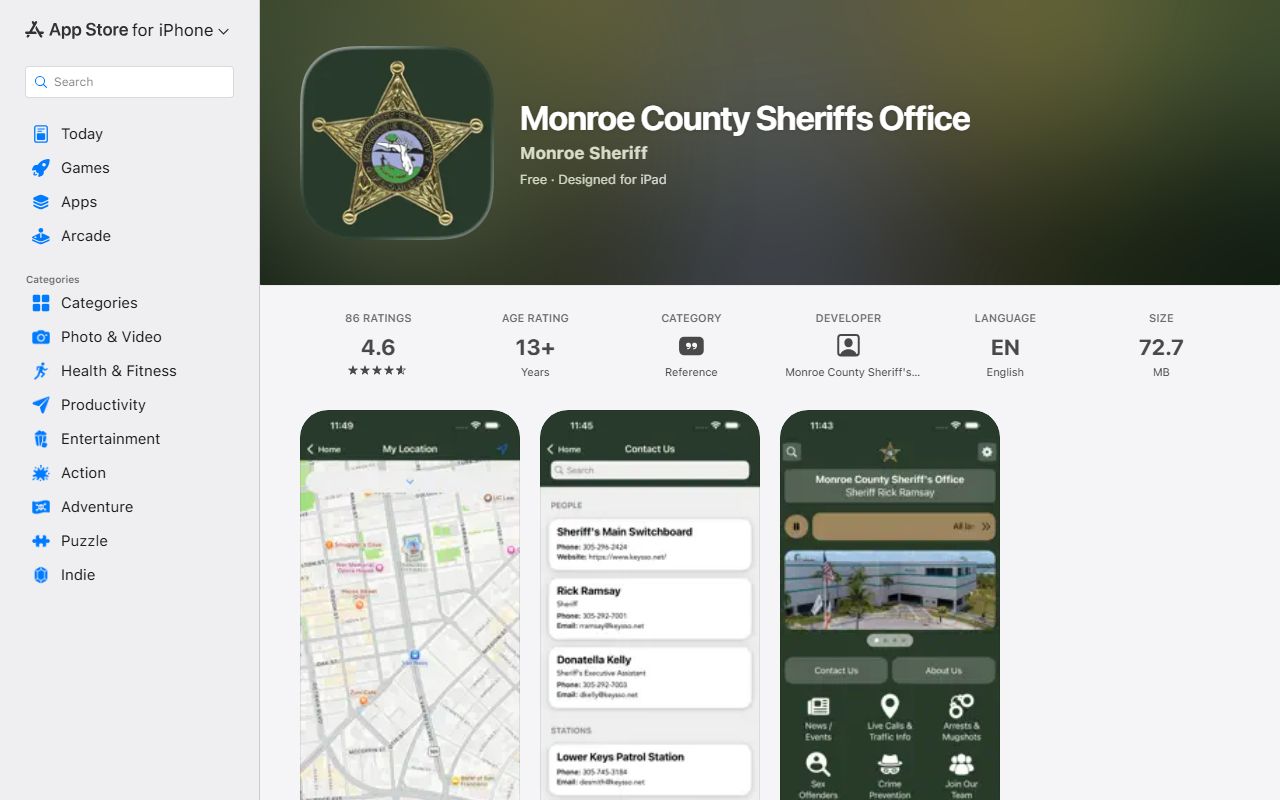
That listing is an information and reference app for the agency, not a confirmed active-warrant search, so a real warrant check still runs through the court clerk or a call to the Sheriff's Office. Treat any app as a starting point, not as proof of your warrant status.
Monroe County Warrant Search Fields
Because there is no public warrant portal, the useful fields are the details you hand a clerk or deputy when you request a check. Having them ready makes the call short and the answer accurate. A common name returns little without a birth date, and a case or citation number is the fastest key of all. The table below lists what to gather before you contact the court or the Sheriff's Records Division.
| Field Label | Type | Required | Notes / Format |
|---|---|---|---|
| Full legal name | Text | Yes | Exact spelling, including middle name and any prior names. |
| Date of birth | Date | Helpful | Separates people who share a common name. |
| Case or citation number | Text | If known | Court-assigned number that ties directly to the underlying case. |
| Issuing court | Selection | Helpful | District, Circuit, or Probate; guides which counter answers. |
| Reason for the check | Statement | Varies | Personal, employment, or housing; a records request may need a form. |
Note: The Sheriff's Records Division may charge a fee for a formal record check and can limit what it releases on an open warrant for safety and investigative reasons.
What a Monroe County Warrant Record Shows
A warrant record is tied to a court case, so its fields mirror that case. What you can actually see depends on whether the matter is public or sealed. A judge, the charge, and a bond amount are often available once a case is filed. A search warrant tied to an open investigation may be entirely nonpublic. The table below lists the fields a warrant record commonly carries and how public each one tends to be.
| Field | What It Shows |
|---|---|
| Person name | The subject of the warrant, available through the court or Sheriff's Office when the case is public and not sealed. |
| Case number | The court-assigned ID that connects the warrant to its underlying case. |
| Charge or violation | The offense; public after filing, though sealed indictments and search warrants can stay nonpublic. |
| Issuing court | The District, Circuit, or other court that authorized the warrant. |
| Bond amount and type | Any bond set by the warrant conditions or at arraignment. |
| Warrant status | Whether the warrant is open or cleared; not reliably shown online, so confirm with the court. |
| Court date | A hearing date that may appear on the daily docket once the warrant is resolved or an arraignment is set. |
Custody Notifications and Sheriff Records
When a warrant leads to an arrest, custody becomes the next question, and Monroe County offers tools for that stage. The Sheriff's Records Division is the formal channel for police reports, local record checks, and freedom-of-information requests, and it operates around the clock. Its record checks are frequently used for employment and housing, and a written request follows the Sheriff's freedom-of-information process.
For custody status, Michigan uses a statewide notification service. VINELink lets a person track whether someone is in custody and sign up for alerts when that status changes, and it is reached at the VINELink custody notification service or by the Michigan VINE toll-free line at 800-770-7657. That service is separate from any warrant search, but it answers the related question of whether an arrest has already happened.
VINELink covers custody and release alerts rather than the warrant itself, so it pairs well with a court call: the court confirms the warrant, and the notification service tracks what happens after a booking. Confirmed bookings also appear on the county jail roster, detailed in the Monroe County inmate records guidance.
Note: Sheriff's Records staff can confirm some record details, but an open warrant may be withheld from public disclosure while it is active, so a court clerk is often the better first call.
Traffic and Failure-to-Appear Warrants
The most common warrants in Monroe County grow out of traffic and district cases. A missed court date or an unpaid fine can turn a routine citation into a bench warrant. For a misdemeanor citation, the district court expects the defendant to contact the court directly, and the traffic line is 734-240-7076. Acting early usually costs far less than waiting for an arrest.
Many of these matters clear with a new hearing date, a payment plan, or a posted bond rather than jail time. The clerk can explain whether a walk-in review is available and what a bond might be. A driver-license hold can ride along with an unpaid traffic case, which is a separate consequence from the warrant and follows its own state process.
What to Do If You Have a Monroe County Warrant
An open warrant does not go away on its own, and a routine stop can turn into an arrest at the worst time. Handling it on your terms is almost always better. The safest path depends on the warrant type, so the felony route and the traffic route are not the same. Legal advice before any contact protects your rights and can shape how the matter resolves.
Important: Talk to a lawyer before you surrender on an arrest or felony warrant, because how and when you appear can affect bond, charges, and your defense.
- Identify the likely source. Traffic and misdemeanor matters point to the district court, while a felony points to the district or circuit court and the prosecutor.
- Call the court first when the case is known, and use 734-240-7076 for misdemeanor citations.
- Ask whether a walk-in warrant review, a bond, or a scheduled hearing is available.
- Consult an attorney if the warrant involves an arrest by the Sheriff's Office before you appear.
- Bring ID and a payment method in case a bond or fine is required, and understand that booking may occur.
- Confirm afterward that the court has recalled or cleared the warrant, since clearance may not be immediate in every system.
If a booking does happen, contact with a jailed person runs through the Monroe County jail's phone and video vendor. Accounts for jail calls are set up through the ICSolutions account portal, the service the county uses for inmate phone and visitation.

That portal handles jail phone and scheduled video visits rather than the warrant itself, so it matters only after a booking, not while a warrant is still open. The full custody and case detail then lives in the county criminal court records.
Anonymous Tips and Non-Emergency Dispatch
Residents who want to report a wanted person, rather than check their own status, have a different set of contacts. The Monroe County Sheriff's Office takes non-emergency reports through its dispatch line at 734-243-7070, and its main law enforcement number is 734-240-7400. An emergency in progress always goes to 911 instead of a records line.
Tips about an active investigation or a person believed to be wanted can go through the Sheriff's Office rather than a court clerk, who handles case records and not field enforcement. The county Sheriff's Office maintains its public contacts and record-request process on the Sheriff's Records Division page. Give as much detail as you safely can, including names, locations, and times.
Note: For any threat to life or a crime in progress, call 911 first; the non-emergency and records lines are for reports and information, not for urgent response.
Sealed and Federal Monroe County Warrants
Not every warrant is open to the public. Search warrants are commonly sealed while an investigation is active, so the record may not exist in any public view until the case matures. Juvenile matters and some family or support warrants carry their own confidentiality rules. A sealed warrant is not an error in a database; it is a deliberate limit set by law or a court order.
Federal warrants sit outside the Monroe County court system entirely. A federal charge is handled in the United States District Court and its appeals run through the U.S. Court of Appeals for the Sixth Circuit, which covers Michigan. Those matters do not appear in Monroe County court files, and the Sixth Circuit Court of Appeals is the appellate level for federal cases from the state.
The Sixth Circuit handles appeals, not the issuing of local warrants, so a Monroe County resident looking for a state warrant still starts with the district or circuit court. A federal warrant, by contrast, is a matter for the federal courts and federal law enforcement.