
Criminal Court Records in Monroe County
A criminal court record is the case file a court opens the moment charges are filed against a defendant. It is not the police arrest report. It is the court's own running account of the prosecution, from the first charge to the last order. The file gathers the charging document, the arraignment, any bond terms, motions, hearing notices, the plea or verdict, the disposition, and the sentence. Once a case closes, that file stays with the court that handled it.
Two trial courts produce most of these records. The 1st District Court handles misdemeanors punishable by up to one year, plus the early stages of felony cases. That early work covers arraignment, bond, and the preliminary examination. If a judge finds probable cause, the felony is bound over to the 38th Circuit Court, the county's general jurisdiction trial court. The County Clerk serves as clerk to the Circuit Court and keeps its case files. So a single felony can leave a trail in both courts before it is resolved.
How to Search Monroe County Criminal Court Records
Most criminal case index and docket data is public through MiCOURT Case Search, the statewide portal that many Michigan trial courts share. It can show civil, traffic, criminal, family, and probate cases, depending on the court chosen. Online data is a starting point, not the full official file. Sealed, nonpublic, and older records still need a direct request to the court.
- Open MiCOURT Case Search and select the 38th Circuit Court or the 1st District Court.
- Search by defendant name when the spelling is reliable, or by case number when you have one.
- Narrow the results by court, case type, and date to trim a common name.
- Open the matching case to read the docket, the charges, and the disposition.
- Request a certified copy from the clerk when a sealed seal or a court-ready copy is needed.
Other channels fill the gaps. Certified copies of Circuit Court files come from the County Clerk. For a defendant already sent to state prison, custody and supervision details sit in the Michigan Department of Corrections offender search, not the county courts. Police and arrest reports behind a charge route through the Sheriff's Records Division. For the full range of civil, family, and probate files, the county's broader court records guidance maps each court to the office that holds it.
Note: MiCOURT lists case activity, but the paper or electronic file kept by the clerk remains the official record for any legal use.
How a Monroe County Criminal Case Moves
A criminal case runs through a set order of steps, and each step leaves a mark in the file. Reading a record is easier when the stages are clear. In Monroe County a felony usually opens in the 1st District Court, then binds over to the 38th Circuit Court for trial or plea. Misdemeanors stay in the District Court from start to finish.
Case flow: Charges Filed › Arraignment › Pretrial and Motions › Plea or Trial › Disposition › Sentencing. For felonies, add the bindover step that carries the case from the 1st District Court to the 38th Circuit Court after a preliminary examination.
| Stage | What Happens |
|---|---|
| Charges Filed | The prosecutor reviews the police report and issues a complaint or warrant that names the charge and statute. |
| Arraignment | The defendant hears the charges, a plea is entered, and the court sets bond or release terms. |
| Preliminary Exam | For a felony, the District Court weighs probable cause and decides whether to bind the case over to Circuit Court. |
| Pretrial and Motions | Lawyers file motions, share evidence, and often negotiate. Hearings and orders are logged in the docket. |
| Plea or Trial | The case ends in a plea or moves to a bench or jury trial that reaches a verdict. |
| Sentencing | After a conviction, the judge orders jail, prison, probation, fines, costs, or restitution. |
What a Monroe County Criminal Court Record Shows
A criminal case file is built from many fields, and each one answers a different question. Some fields identify the case. Others track the charge, the money owed, and the outcome. The list below covers what a public Monroe County criminal record commonly displays, though the exact layout shifts with the court and the case type.
| Field | What It Shows |
|---|---|
| Case Number | The court-assigned number; Michigan numbers often end in a two-letter case-type code such as FC or FH for felony matters. |
| Court | Whether the 38th Circuit Court, the 1st District Court, or another court holds the file. |
| Defendant | The person charged, sometimes with a birth year to separate common names. |
| Charges | Each charge name, the statute cited, and whether it is a misdemeanor or a felony. |
| Bond | The amount or conditions set for release before the case is resolved. |
| Plea | The formal answer entered, such as guilty, not guilty, or no contest. |
| Disposition | The outcome for each charge, such as convicted, dismissed, or acquitted. |
| Sentence | Any jail, prison, probation, fine, cost, or restitution ordered after a conviction. |
Financial lines matter as much as the charge lines. A record can list fines, court costs, restitution to a victim, and probation terms that stretch for years. Redactions are normal too. Social Security numbers, victim contact details, and minor identifiers are shielded under Michigan court rules even when the rest of the file is open.
Charges vs Convictions in Monroe County
Being charged is not the same as being convicted. A criminal court record can show charges that were later dropped, dismissed, reduced, or that ended in an acquittal. A charge is an accusation. A conviction is a proven result. Reading the two as if they mean the same thing is a common and costly mistake.
| Charge | Conviction | |
|---|---|---|
| Stage | The accusation the prosecutor files | The verdict or accepted plea |
| Standard | Probable cause to proceed | Proof beyond a reasonable doubt |
| Can Change | Amended, reduced, dropped, or dismissed | Stands unless appealed or set aside |
| Public Record | Usually yes, once filed | Yes, unless later set aside |
The charge side of a case has its own detail, from the complaint to charge codes and status changes. A closer look at how charges are filed and how they shift lives in the Monroe County arrest records and court charges guidance. This page stays with the case file the court keeps once the charge becomes a case.
Who Prosecutes Monroe County Criminal Cases
The Prosecuting Attorney drives the criminal side of the courts. In Michigan, counties use a Prosecuting Attorney rather than a District Attorney. The Monroe County office is led by an elected prosecutor who serves a four-year term and acts as the county's chief law enforcement official. State law requires a Chief Assistant Prosecuting Attorney in every county, and Monroe County staffs eleven more assistant prosecutors on top of that.
The prosecutor reviews police reports, decides which charges to authorize, and represents the People at each stage. That work runs from arraignment through the preliminary examination, plea talks, trial, and sentencing. The office also handles victim and witness assistance and posts steps in a prosecution for the public. The Monroe County Prosecuting Attorney page lays out that role and links its charging and victim resources.
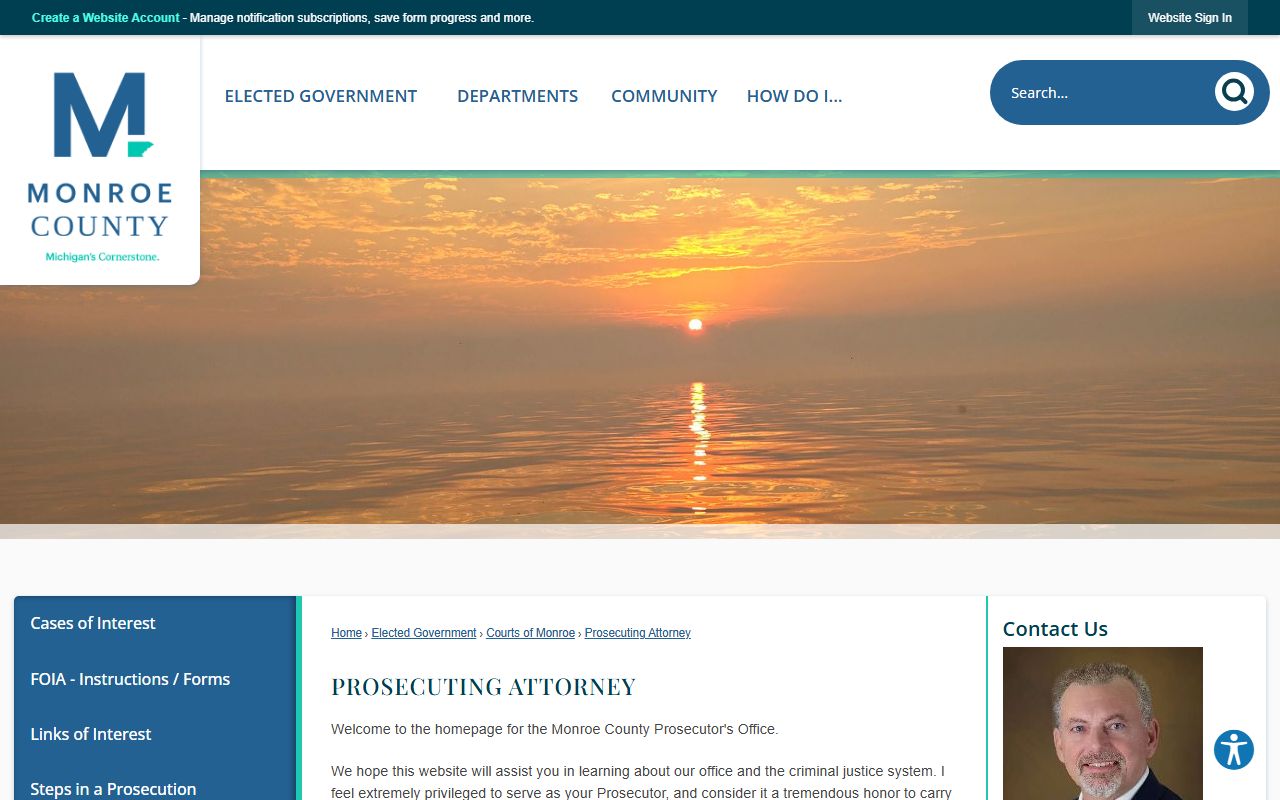
That page is the starting point when a criminal record raises a charging question the court file alone does not answer. It explains why a charge was authorized and how the office moves a case forward.
Monroe County Prosecutor and Defense Offices
Two offices sit on opposite sides of a criminal case, and both leave contact trails a record researcher can use. The prosecutor's staff directory lists the office address, its main line, and a witness hotline. That directory is the fastest way to reach the unit handling a specific charge or victim question.
The Prosecuting Attorney staff directory carries the office address at 125 East Second Street, the main phone at 734-240-7600, and the witness hotline at 734-240-7601.
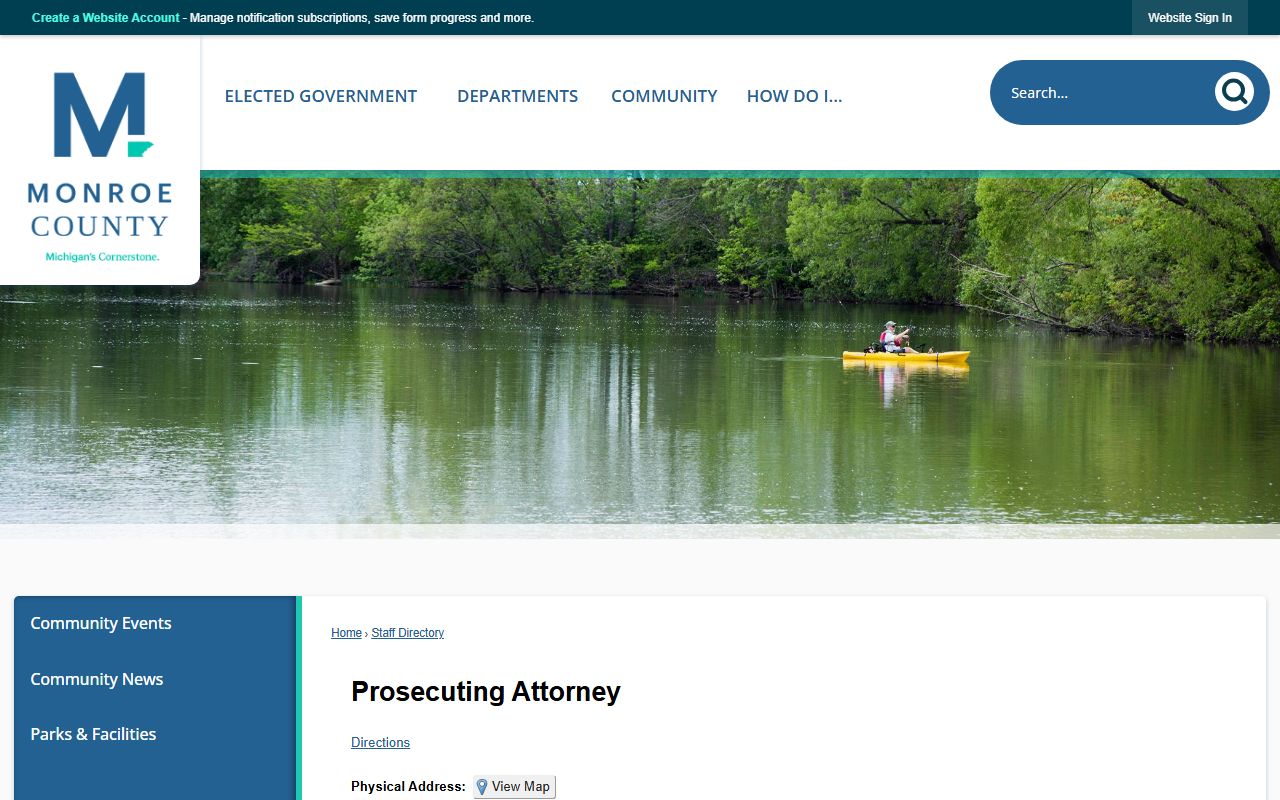
Use that directory when a case file names a charge but you need the person handling it. Defendants who cannot afford a private lawyer are served on the other side by the county's assigned defense system.
The Monroe County Indigent Defense page describes appointed representation for residents who qualify. The county is moving the administrative side of that system from the courts to county management, with study underway toward a possible public defender office.
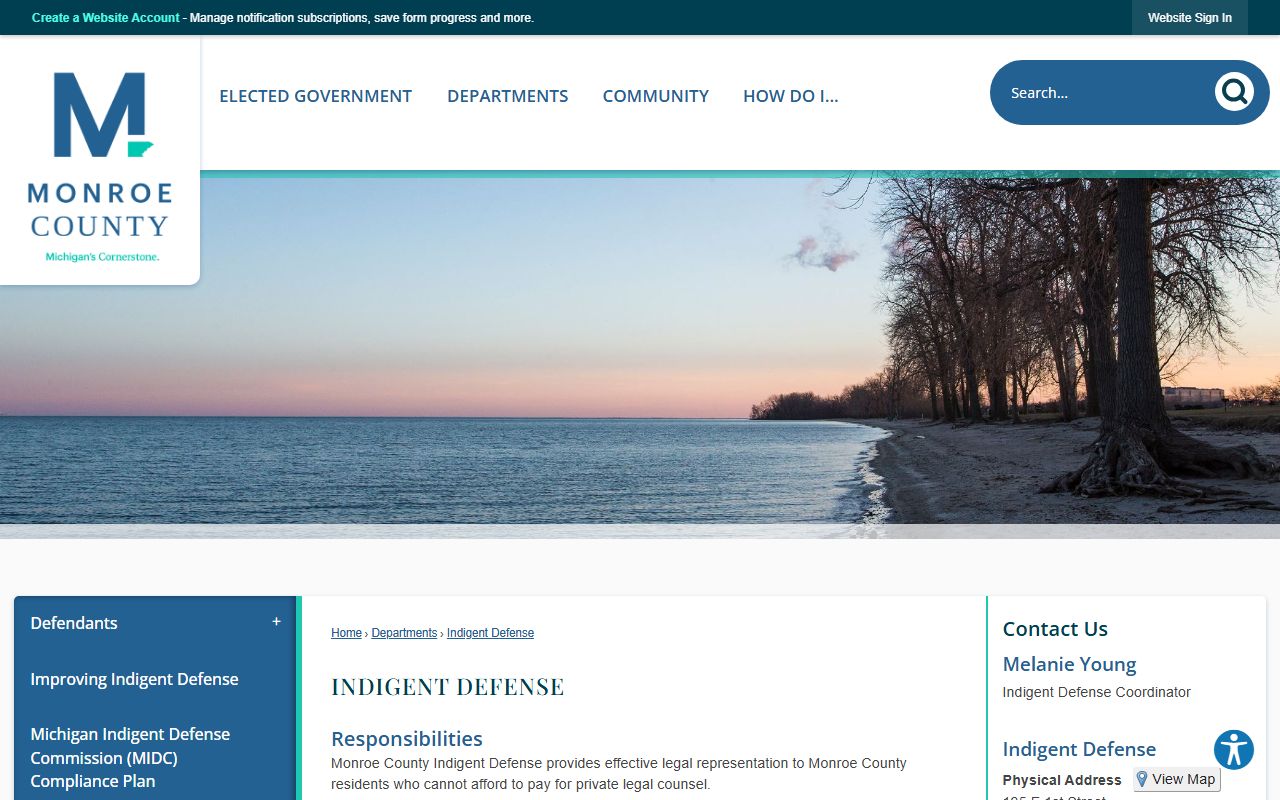
That resource matters because appointed counsel appears throughout a criminal file, from arraignment to sentencing. Knowing which lawyer stood for the defense helps explain the motions and pleas the docket records.
Public Access to Monroe County Criminal Records
Criminal case files are open by default, but the rules that open them are not one law. Court files run mainly on Michigan Court Rules, while sheriff reports and county records run on the Freedom of Information Act. Start with the court's own search for index and docket data, then request the full file from the clerk that owns it.
Key authorities:
MCR 8.119 governs how Michigan courts keep, share, and seal case records, and what clerk duties apply.
MCL 15.231 sets Michigan's public policy of access to public-body records, subject to stated exemptions.
The limits are just as real as the access. Nonpublic, sealed, juvenile, adoption, and mental health matters need party status, attorney status, statutory access, or a court order. A public search may show nothing for those files, so a blank result does not always mean a clean history.
Setting Aside a Monroe County Conviction
Michigan lets people clear some convictions from public view through a set-aside. A set-aside makes an eligible conviction nonpublic, though it is not the same as deleting every government trace. The main path uses a state court form and a filing in the court where the conviction happened.
Eligibility runs through the adult set-aside statute, MCL 780.621 and the sections that follow it. Applicants generally file the SCAO Application to Set Aside Conviction, form MC 227, using a separate application for each court. In Monroe County that means the 1st District Court for eligible district convictions and the 38th Circuit Court for eligible circuit convictions.
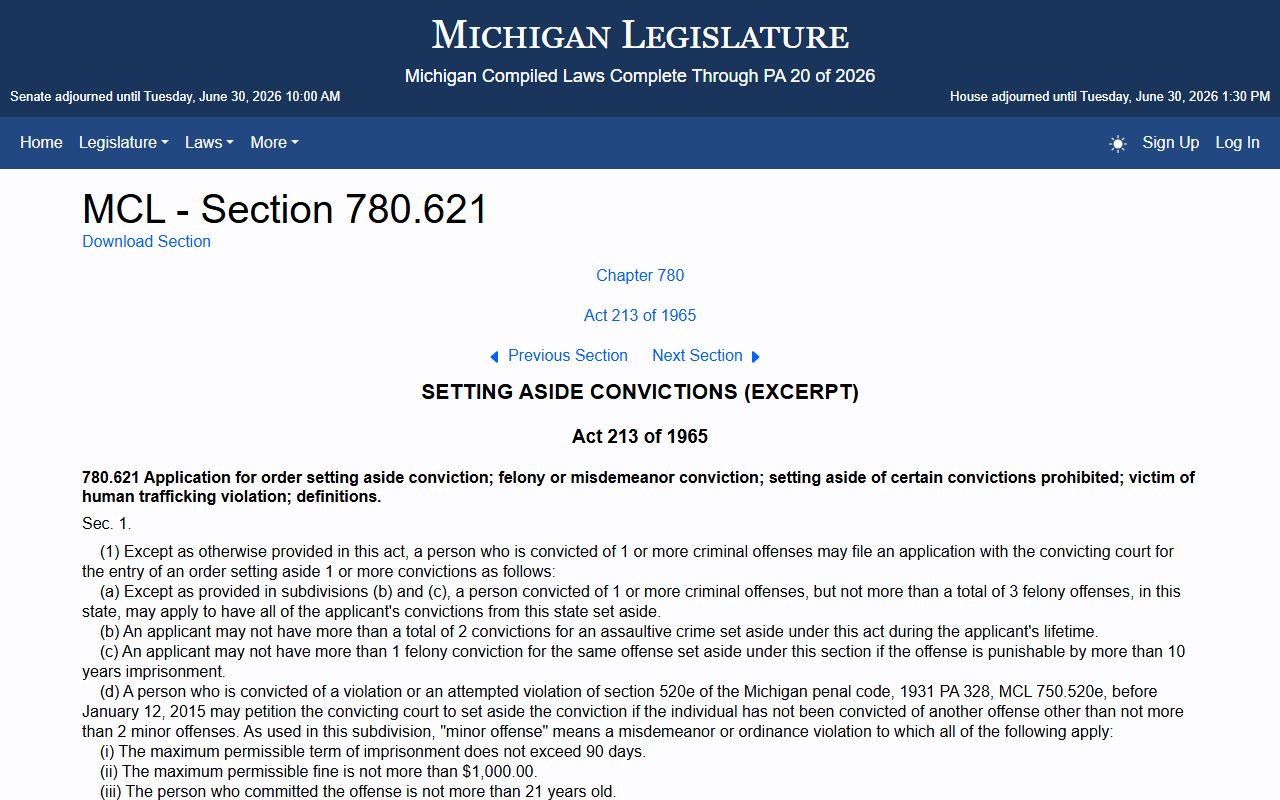
The statute and the form spell out who qualifies and how the process runs, including special forms for certain marijuana and human-trafficking-victim convictions. Traffic offenses carry their own rule, since a traffic set-aside cannot force removal from a driving record.
Sealed vs Expunged Criminal Records
People often use "sealed" and "expunged" as if they mean one thing. They do not. Sealing hides a record from ordinary public view while keeping it in existence. Expungement, which Michigan handles through the set-aside process, treats an eligible conviction as nonpublic and off the public case search. Even then, some access can remain for law enforcement and certain legal uses.
| Sealed | Expunged / Set Aside | |
|---|---|---|
| Public View | Restricted by rule or court order | Removed from public case search |
| Law Enforcement | Limited access remains | Certain statutory access can remain |
| How It Happens | Statute, court rule, or judge's order | Set-aside filing under state statute |
| Eligibility | Set by the sealing rule or order | Set by MCL 780.621 and related sections |
Michigan's Clean Slate program expanded who can clear a conviction, and some records now set aside automatically. The Michigan State Police Clean Slate page explains what set-aside status changes and what it does not.
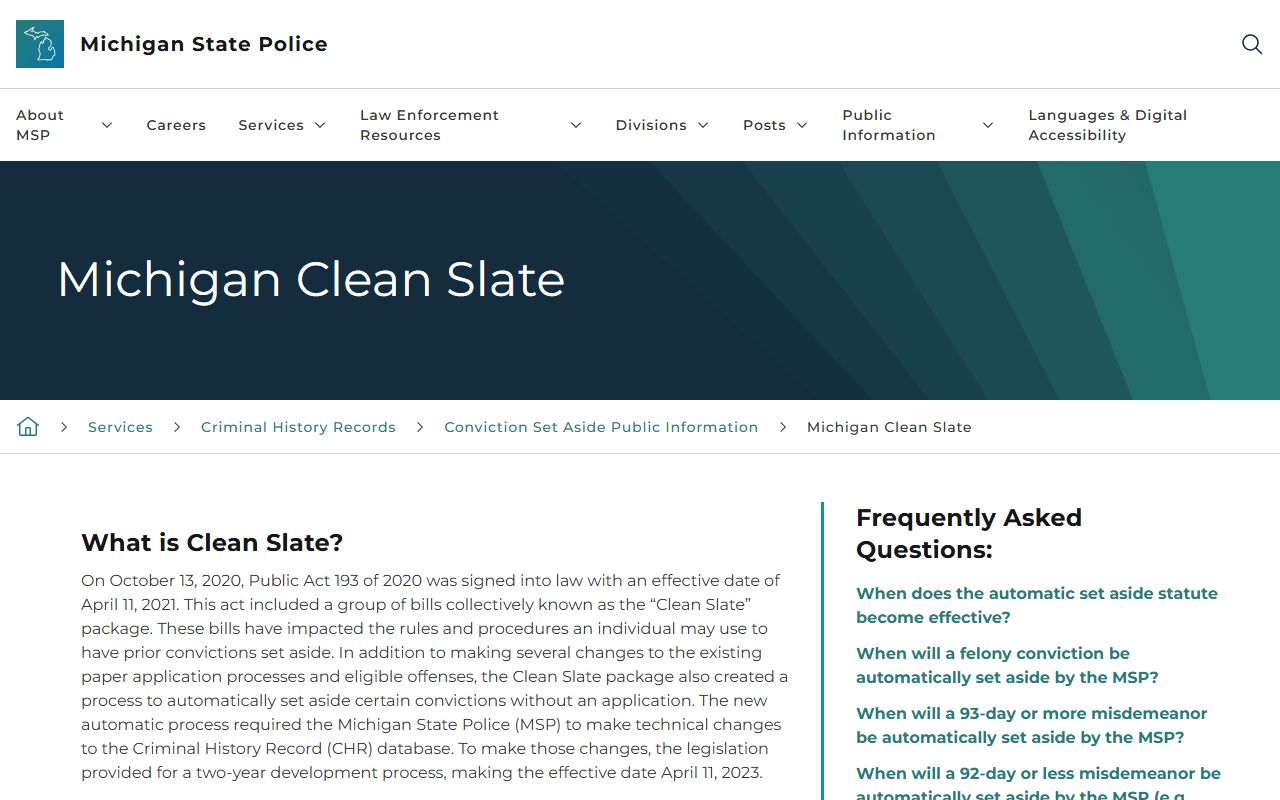
That page is the plain-language reference when a Monroe County criminal record is set aside but a trace still appears in some system. It clarifies why restitution and certain access provisions can survive a set-aside.
Note: A set-aside does not erase every record; law enforcement and some statutory users can still reach details that the public case search no longer displays.
Restricted Monroe County Criminal Records
Not every criminal file is open to a public search. Juvenile delinquency and child protective matters are not treated like ordinary adult cases, and access can be limited to parties, attorneys, agencies, and court order. Sealed and set-aside cases drop off the public view. Search warrants tied to an active investigation are often sealed while the work continues.
Sensitive data is shielded even inside open files. Social Security numbers, financial account numbers, birth dates, minor identifiers, and victim contact details may be redacted under Michigan court rules. Parties and lawyers who need a restricted file should contact the court directly rather than rely on the online index.
How Criminal Records Link to the Jail Roster
A criminal case and a jail booking are two views of the same person, kept in different systems. The court file tracks charges and outcomes. The jail roster tracks who is in custody right now. They connect at the start of a case, when an arrest leads to a booking and then to a charge in court.
The Monroe County jail roster runs on the Zuercher Portal, which the Sheriff's Office configures. It can show a booking, descriptive details, and the offenses the arresting agency listed. That live booking data does not replace the court file, and the two can differ, since the prosecutor may change the charges the police first listed. For custody and booking detail, the county's inmate lookup portal is the current-status tool, while the court record carries the case through to disposition and sentence.
Note: The jail roster reflects arresting-agency charges at booking, so always confirm the final charges and outcome in the court case file itself.