
How to Search Monroe County Court Records
The main public search tool for Monroe County court records is MiCOURT Case Search. This is the statewide case lookup that Michigan trial courts share, and you can reach it at the MiCOURT Case Search portal. The state describes it as a way to find civil, traffic, criminal, domestic, and probate cases, though what shows up depends on the court you pick. Monroe County links to it from the county court landing page, the 38th Circuit Court page, and the 1st District Court page.
Before you start, gather what you know. A case number is the fastest key. Michigan case numbers usually end in a two-letter code that names the case type. If you only have a name, spell it exactly and be ready to narrow by court. Online case data is an index, not the full official file, so plan to reach the clerk for sealed, older, or complete documents.
- Decide which court holds the case. Felonies, divorce, and civil claims over $25,000 begin in the 38th Circuit Court. Misdemeanors, traffic, small claims, and landlord-tenant matters begin in the 1st District Court. Estates and guardianships sit in Probate Court.
- Open the county court landing page if you are unsure. It lists each court, Friend of the Court, the Prosecuting Attorney, and the public-access links in one place.
- Run MiCOURT Case Search for Circuit or District case data. Enter a case number when you have one. Use a party name only when the spelling is reliable, and narrow by court or case type.
- Confirm hearing dates through the daily docket links. Treat a public calendar as a guide, not as a summons or a legal notice to appear.
- Use the Probate public-access portal for estate, guardianship, and conservatorship matters when those are the records you need.
- Request full files or certified copies from the clerk who owns the case. Sheriff reports and crash reports go through the Sheriff's Records Division, not MiCOURT.
The Michigan Courts overview explains how the state judiciary fits together and how each trial court connects to the appellate system, as shown on the Michigan Courts overview page.
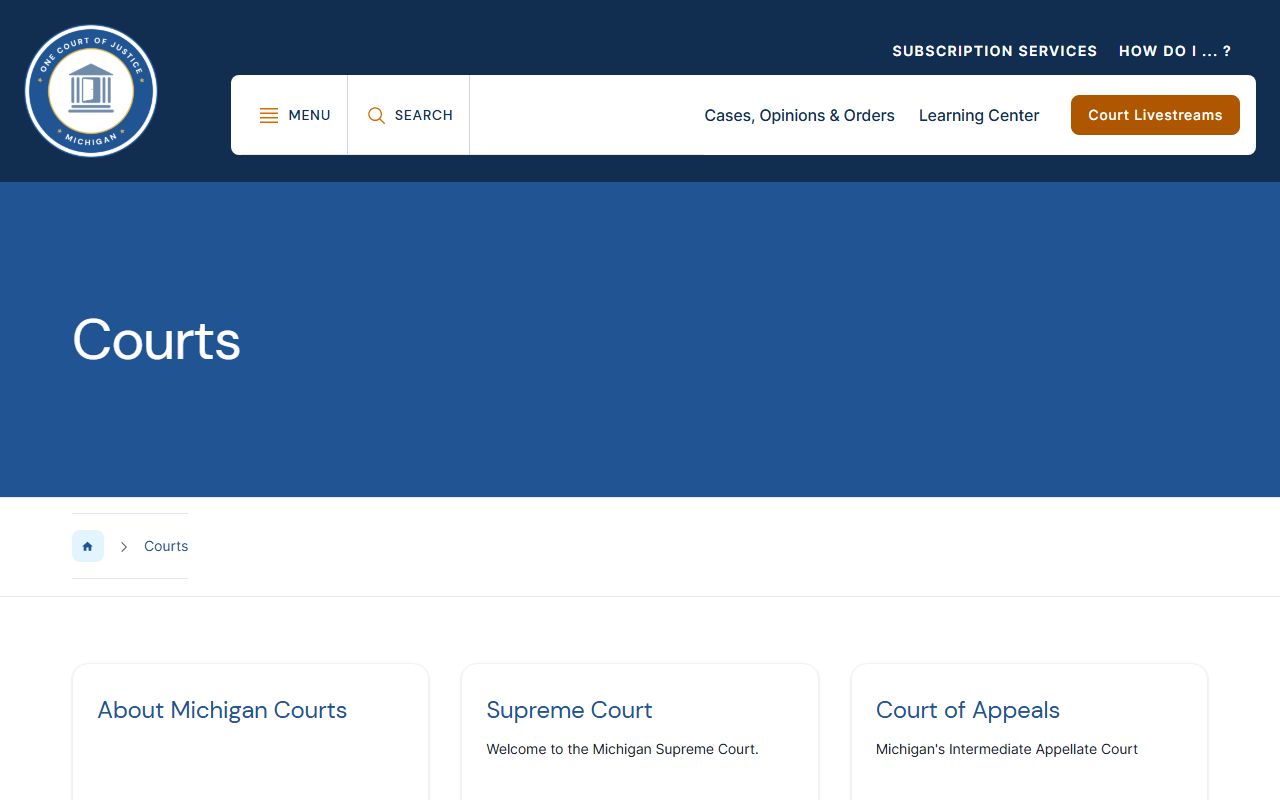
That overview is the map that places the 38th Circuit Court and the 1st District Court inside Michigan's full court structure, which helps when a Monroe County case may cross more than one court level.
Monroe County Court Records Search Fields
MiCOURT asks for a few pieces of information before it returns Monroe County court records. The exact labels can shift because the search screen is dynamic, but the core fields stay steady across participating courts. You choose a court first, then pick how you want to search. A case-number search is precise. A name search is broader and often needs a birth year to trim the list on criminal or traffic matters.
| Field Label | Type | Required | Notes / Format |
|---|---|---|---|
| Court | Dropdown / selector | Yes | Pick the participating court; Monroe options include the 38th Circuit Court and the 1st District Court. |
| Search by | Tabs / radio path | Varies | Choose a party name, case number, or related path. |
| Case Number | Text | Only for case-number search | Court-assigned number; Michigan numbers commonly end with a two-letter case-type code. |
| Last Name / Business Name | Text | Only for name search | Used for party searches; the exact minimum-character rule is not published. |
| First Name | Text | Optional | Narrows a person search. |
| Date / Year of Birth | Date / year | Optional | Often requested to narrow criminal or traffic name searches. |
| Case Type / Court Type | Dropdown / filter | Optional | Civil, traffic, criminal, domestic, or probate, depending on the court chosen. |
Note: The live portal may add terms-of-use screens and search or reset buttons, so field labels can differ slightly from the static descriptions the courts publish.
Which Courts Hold Monroe County Records
No single office keeps every Monroe County court record. The county runs three trial courts, and each owns its own files. Where a case sits decides where the record lives and how you reach it. A single criminal matter can even touch two courts, since a felony often opens for arraignment and a preliminary exam in the 1st District Court, then moves to the 38th Circuit Court after bindover.
The 38th Circuit Court is the general-jurisdiction court. It holds felony files, civil cases over $25,000, and Family Division matters such as divorce, personal protection orders, and juvenile cases. The 1st District Court is the high-volume court for traffic, misdemeanors, small claims up to $6,500, landlord-tenant disputes, and civil claims up to $25,000. Probate Court keeps estate, guardianship, conservatorship, and mental health files, and it runs its own public search at the Probate public-access portal.
- Circuit civil and felony files: complaints, motions, orders, plea and sentencing records, and judgments.
- District files: traffic citations, misdemeanors, small claims, garnishments, and eviction records.
- Family Division files: divorce, custody, support, and personal protection order records.
- Probate files: wills, estate inventories, guardianships, and conservatorships.
Estate and guardianship files run on a separate track, so the deeper walkthrough for those lives with the Monroe County probate records guidance. Appeals move up a different ladder. District rulings can be appealed to the Circuit Court, while Circuit rulings head to the Michigan Court of Appeals, searchable through the Michigan appellate case search.
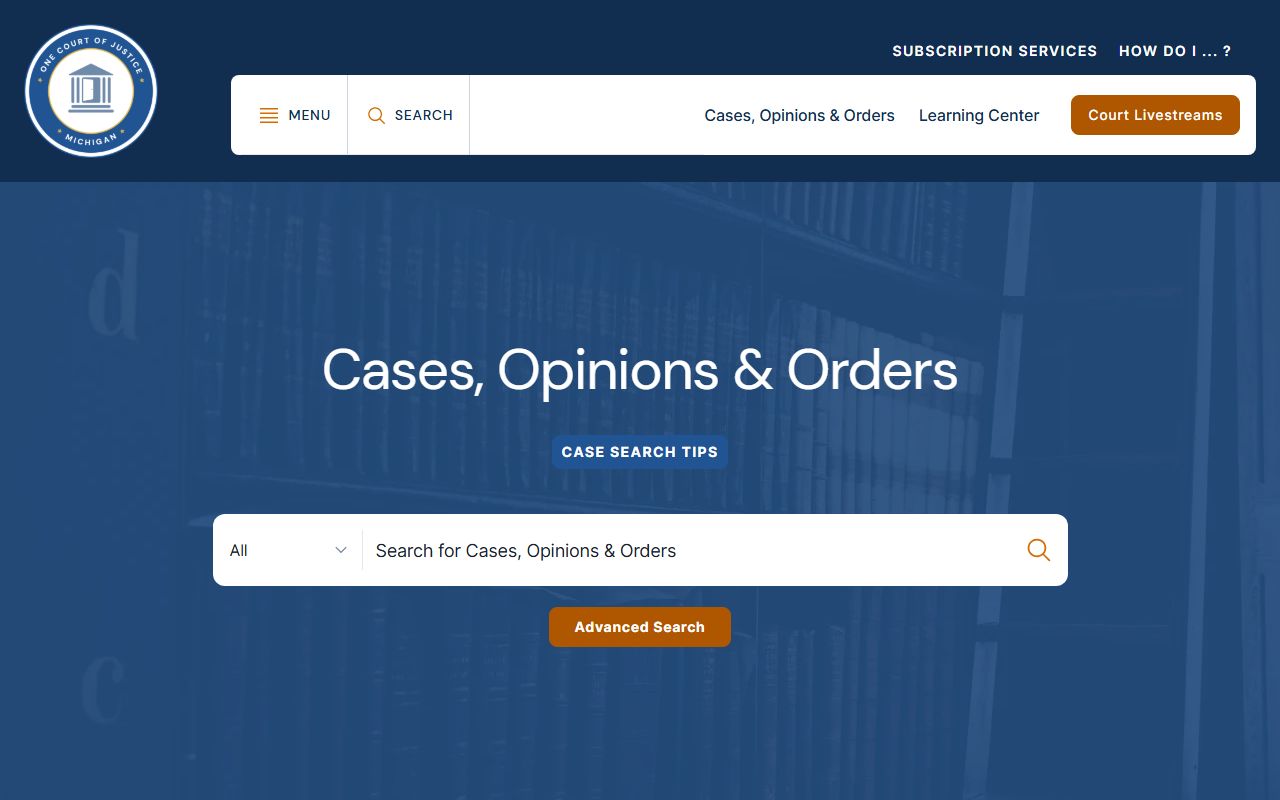
That appellate tool covers opinions and orders from the higher courts, so a Monroe County case that has left the trial level is found there rather than in the local MiCOURT search.
What Monroe County Court Records Show
A Monroe County court record is more than a name and a number. Open a public case and you usually see the parties, the charge or claim, every docket event, and the outcome. Some data stays hidden by rule, such as Social Security numbers, financial account numbers, and the names of minors. The table below lists the fields you can expect to read on a public file.
| Field | What It Shows |
|---|---|
| Case Number | The court-assigned ID, ending in a two-letter code that names the case type. |
| Court | 38th Circuit, 1st District, Probate, or an appellate court. |
| Filing Date and Status | When the case opened and whether it is open, closed, dismissed, or stayed. |
| Parties | Plaintiff and defendant, petitioner and respondent, or estate and decedent names. |
| Charges / Case Type | Charge name and statute, civil claim, probate type, or domestic matter. |
| Docket Entries | Each filing and event, from complaint and motion to plea, order, and judgment. |
| Hearings | Date, time, judge or referee, and courtroom or floor. |
| Financials | Fines, costs, restitution, bond, and any payment plan. |
| Documents | Pleadings, orders, and judgments; online availability varies and may need a clerk request. |
Some of the words on a docket carry a precise legal meaning. A few common terms are defined below so the record reads clearly.
- Disposition
- The outcome of the case.
- Bindover
- The transfer of a felony from District Court to Circuit Court after a probable-cause finding.
- Bench warrant
- A warrant a judge issues, often after a missed hearing or contempt.
- Default judgment
- A ruling entered when a party fails to answer or appear.
- Set aside
- A Michigan process that makes an eligible conviction nonpublic.
Public Access Laws for Monroe County Records
Two bodies of law shape access to Monroe County court records. Court files follow the Michigan Court Rules, while sheriff reports and county administrative records follow the state Freedom of Information Act. Knowing which set applies tells you where to knock and what to expect.
Court records fall under MCR 8.119 in Chapter 8 of the Michigan Court Rules, which governs case-record access, redaction, sealing, and clerk duties. A related rule, MCR 1.109, requires that protected personal identifiers be shielded, which is why some data is stripped from a public file. Police reports, crash reports, and other county records instead run through the Michigan Freedom of Information Act. Its public-policy section, MCL 15.231, states that public bodies must generally let people inspect and copy records after a written request, unless an exemption applies.
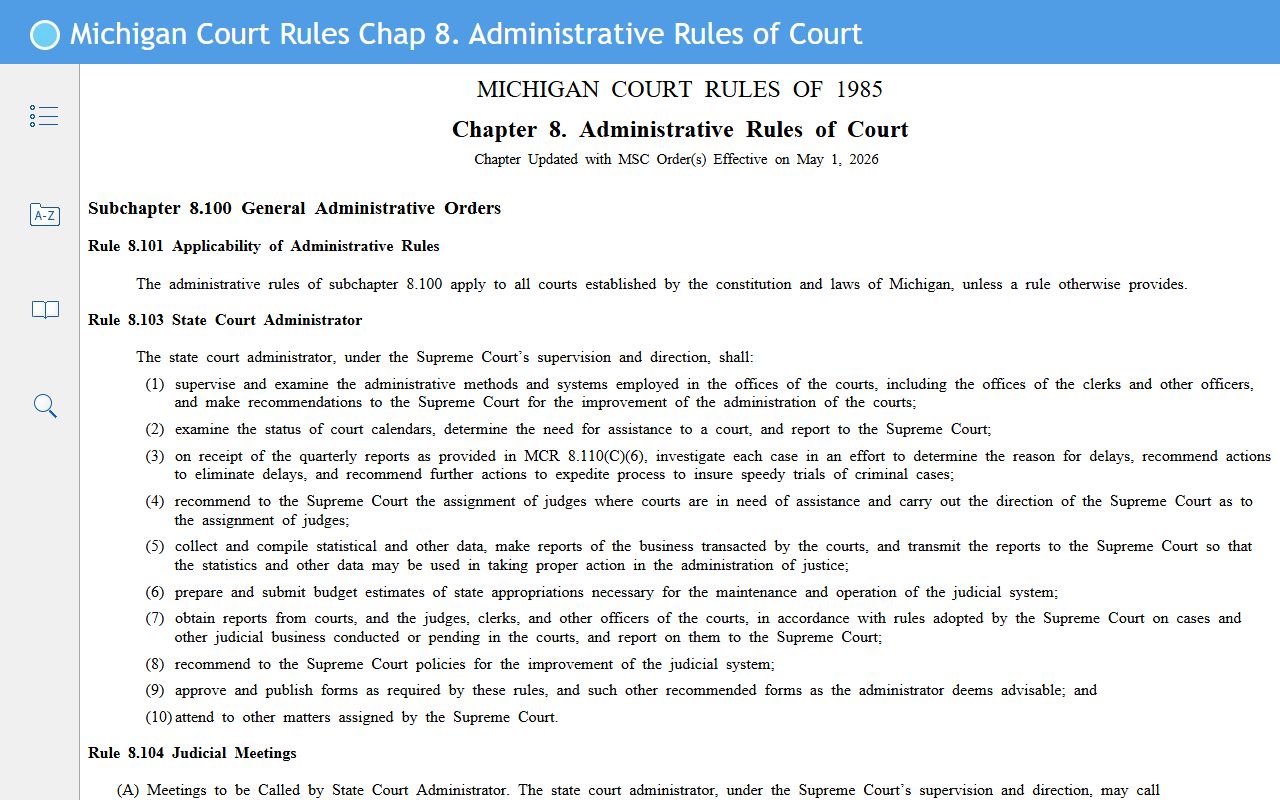
Chapter 8 is the rulebook a clerk points to when deciding what a member of the public may copy, so it is the backbone of every open Monroe County court record.
Note: Online case information is a search index, not the full official file, so a sealed, nonpublic, or older document may not appear even when the case does.
Certified Copies From the County Clerk
A screen printout is fine for a quick check. A court proceeding, a passport, or a title transfer usually needs a certified copy with a raised seal. In Monroe County, the County Clerk and Register of Deeds issues certified copies of Circuit Court records and of vital records such as birth, death, marriage, and divorce certificates. The office explains the process on its Certified Copies page.
The Clerk accepts requests in person, by mail, and through the courthouse drop box. Court filings, though, are not accepted by email or fax, and personal checks are not taken for certain services. The published copy fee for court and vital records is set by the office and is best confirmed with the Clerk before you send payment, since exact amounts change. Reaching the office directly is the surest way to price and complete a certified request.
County Clerk / Register of Deeds
106 E First Street
Monroe, MI 48161
734-240-7020
In person, by mail, or drop box; no email or fax filings
Note: A certified copy carries the Clerk's raised seal and is the version courts and agencies accept, while an uncertified online printout is only for reference.
Sheriff Records and Police Report Access
Not every record tied to a case comes from a court. Arrest reports, incident reports, crash reports, and local record checks come from the Sheriff's Office, and MiCOURT does not carry them. The Sheriff's Records Division handles these requests and publishes its own path for the public.
The division sits at 100 E Second Street in Monroe and stays open around the clock. It accepts Freedom of Information Act requests by email and charges a set fee for a local record check. Because a police report and a court file answer different questions, a full picture of a case often means asking both the court clerk and the Sheriff. The division outlines its options on the Public Resources Records Division page.
Sheriff's Records Division
100 E Second Street
Monroe, MI 48161
734-240-7415
Open 24 hours; FOIA by email at foia_sheriff@monroemi.org
Federal Court Records for Monroe County
Some cases that touch Monroe County are not state cases at all. Monroe County sits in the federal Eastern District of Michigan, and federal civil and criminal matters are not searched through the county courts. The trial court for those cases is the U.S. District Court for the Eastern District of Michigan, which handles federal civil and criminal filings from the region.
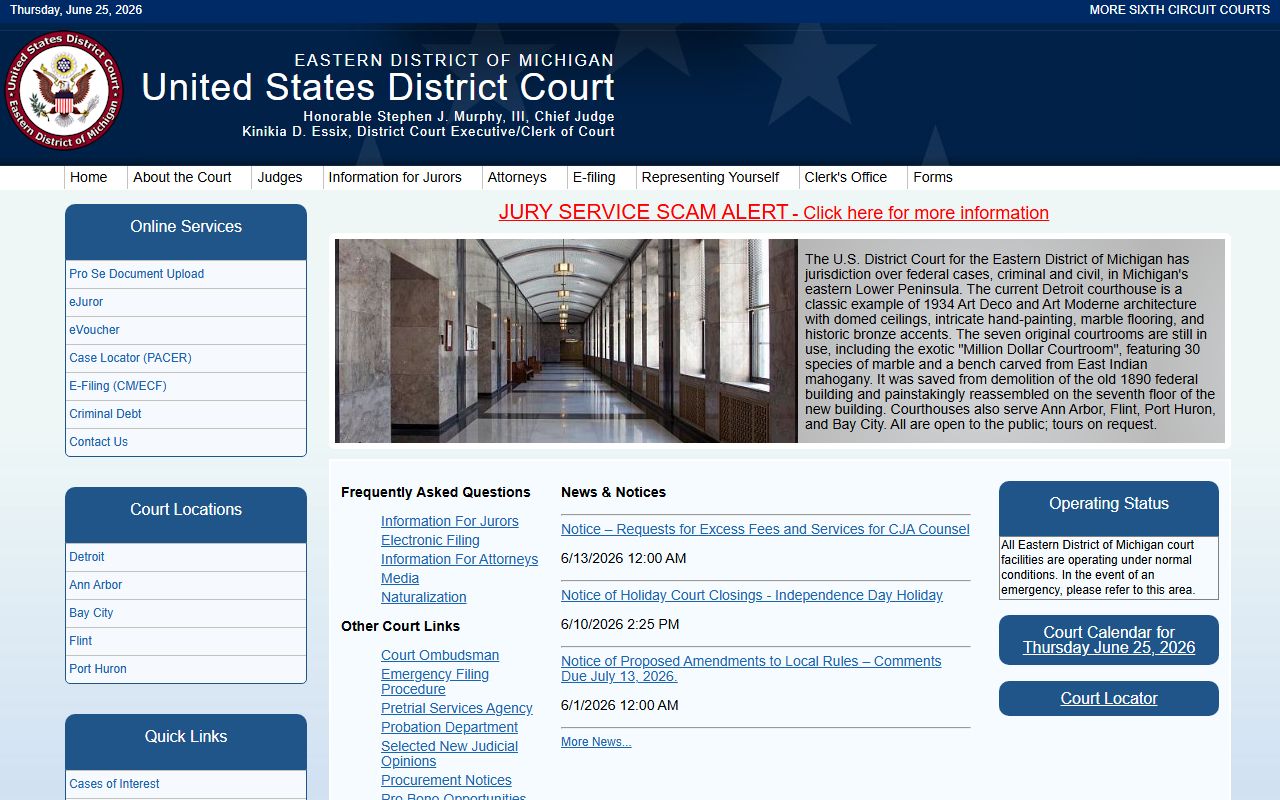
A Monroe County resident charged or sued in federal court finds that file in the Eastern District system rather than in any county court record. Federal docket access runs through PACER, the national service for court dockets and case data, available at the federal PACER site.
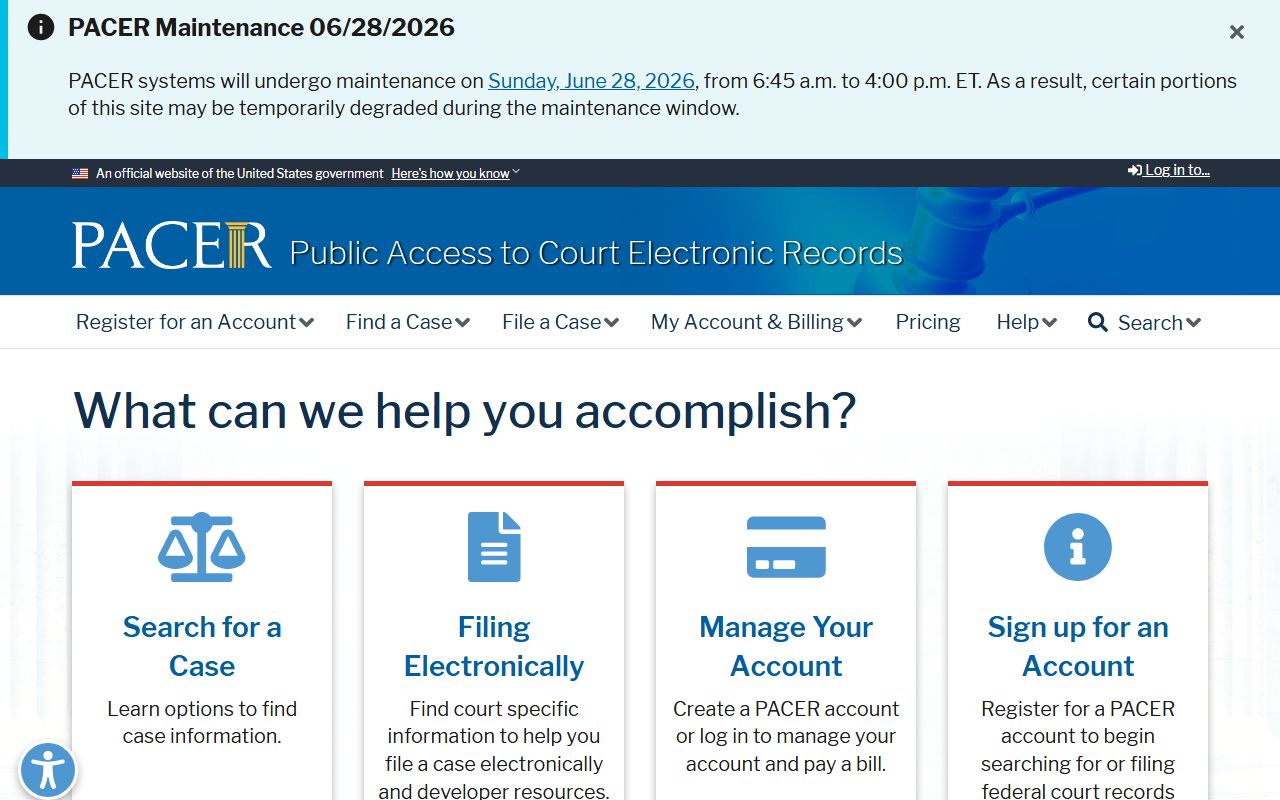
PACER requires registration for most document access, and its fees are set at the federal level. Bankruptcy cases go to the U.S. Bankruptcy Court for the Eastern District of Michigan, while appeals from the district court move to the U.S. Court of Appeals for the Sixth Circuit.
Restricted Monroe County Court Records
Public access has limits, and some Monroe County court records are closed by rule or statute. Juvenile delinquency and child protective files, adoption files, and probate mental health records are not treated like ordinary adult cases. Access may be limited to the parties, their attorneys, certain agencies, or a court order. Protected identifiers, victim contact details, and minor names are also redacted from otherwise public files.
A set-aside is another reason a record may vanish from a public search. Under Michigan's Clean Slate laws, an eligible conviction can be set aside and made nonpublic, though some law-enforcement access can remain. The core adult set-aside statute is MCL 780.621. To view or restore access to a sealed file, a party or attorney generally files in the court where the case happened. For an eligible district conviction that means the 1st District Court, and for an eligible circuit conviction that means the 38th Circuit Court. When a public search shows nothing, calling the court that owns the case is the reliable next step.
Note: A set-aside makes an eligible conviction nonpublic but does not erase every government trace, and traffic set-asides carry their own rules about the state driving record.