
How to Search Monroe County Court Records
Most Monroe County court records start with one free tool. The Michigan MiCOURT Case Search covers Monroe County circuit and district cases for many trial courts across the state, and Monroe County links to it from its court pages. Civil, traffic, criminal, domestic, and probate cases may show up, depending on the court you pick. The county court landing page ties the whole system together in one spot.
Before you begin, gather what you know. A case number gives the cleanest hit. A full name works too, but common names return long lists, so a birth year or case type helps narrow things. Online case data is an index, not the full paper file, so plan to call or visit the clerk for certified copies or sealed matters.
Monroe County posts its main court divisions and public access links on the Courts of Monroe landing page, which is a good place to begin when you are not sure which court holds a case.
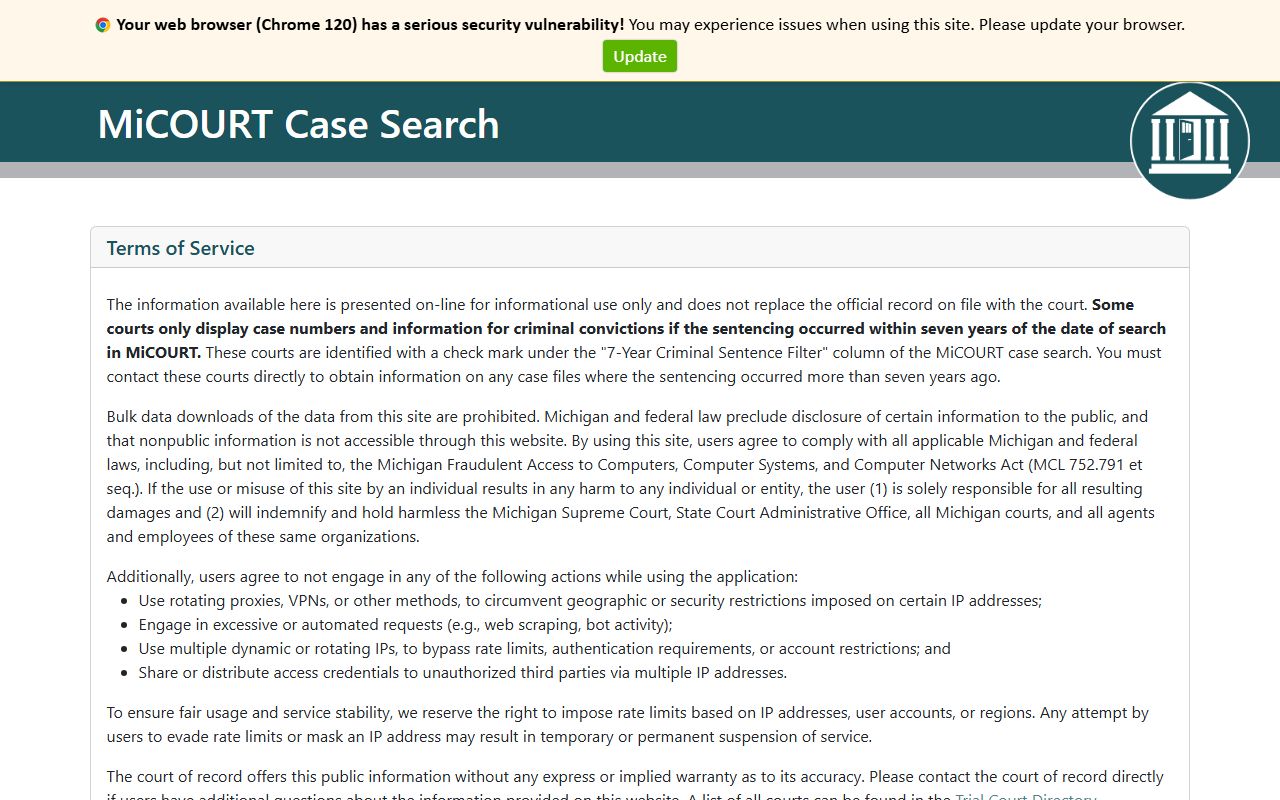
The MiCOURT Case Search portal lets you pick a court, then search by name or case number. Results show the case index and docket entries, while the official file stays with the court clerk.
- Decide which court hears the case. Felonies and larger civil suits sit in Circuit Court, while traffic, misdemeanors, and small claims sit in District Court.
- Open MiCOURT Case Search and select the participating Monroe County court you need.
- Enter a case number when you have one, or search by last name and first name.
- Narrow the results by case type or date to reach the right party.
- Review the docket entries, hearing dates, and case status shown on screen.
- Request a certified copy or full file from the clerk when the online index is not enough.
Note: Online case information is not always the complete official record, so confirm details with the court clerk before relying on any Monroe County court records for a legal purpose.
The Monroe County Judicial System
Michigan runs a layered court system, and Monroe County uses every layer. The Michigan Supreme Court leads the state judiciary. Below it, the Michigan Court of Appeals is the intermediate appellate court. In Monroe County, trial work is split among three courts: the 38th Circuit Court, the 1st District Court, and the Probate Court. Each court keeps the records for the cases it hears.
The 38th Circuit Court is the general trial court. It handles felonies, civil suits over $25,000, family matters, and appeals from the district court. The 1st District Court is the high-volume "people's court" for traffic, misdemeanors, landlord-tenant cases, and small claims. Probate Court handles estates, guardianships, and mental health matters. You can read the county's own summary on the Michigan trial courts page.
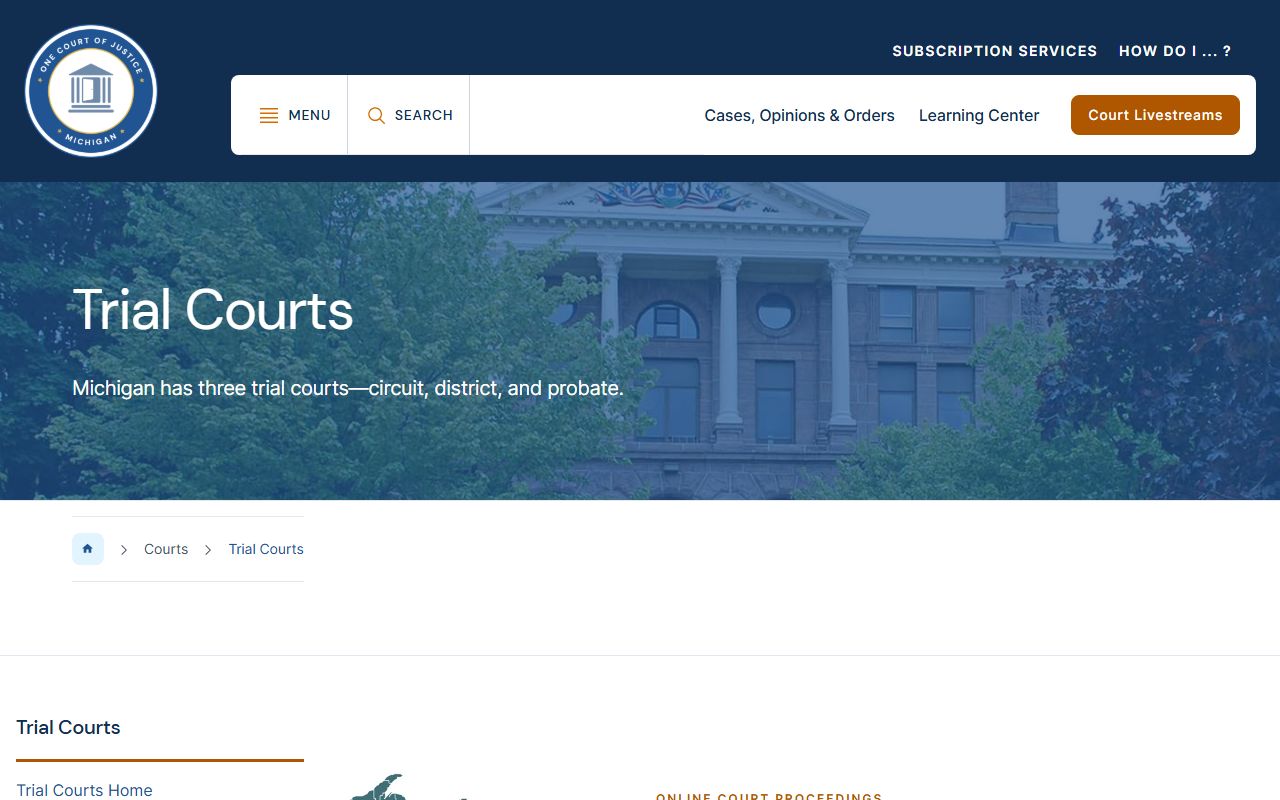
That state page explains how circuit, district, and probate courts divide the work statewide, which mirrors how Monroe County splits its own caseload.
Case flow: District Court arraignment › Preliminary exam › Bindover › 38th Circuit Court › Michigan Court of Appeals › Michigan Supreme Court
| Court | Jurisdiction | Case Types |
|---|---|---|
| 38th Circuit Court | General trial court | Felonies, civil over $25,000, family, PPOs, district appeals |
| 1st District Court | Limited trial court | Traffic, misdemeanors up to one year, civil up to $25,000, small claims, landlord-tenant |
| Probate Court | Probate and juvenile | Estates, guardianships, conservatorships, mental health, name changes |
| Michigan Court of Appeals | Intermediate appellate | Appeals from circuit court final orders |
A single case can cross courts. A felony often opens in the 1st District Court for arraignment, bond, and a preliminary exam, then binds over to the 38th Circuit Court if a judge finds probable cause. Learn more about the general trial court on the Monroe County Circuit Court page.
Monroe County Trial Courts Compared
The three Monroe County trial courts look alike from the outside, yet they handle very different files. Choosing the wrong one wastes a trip. The chart below sorts the courts by what they hear, the dollar limits that apply, and where the records live. Use it to aim your search before you type a single name.
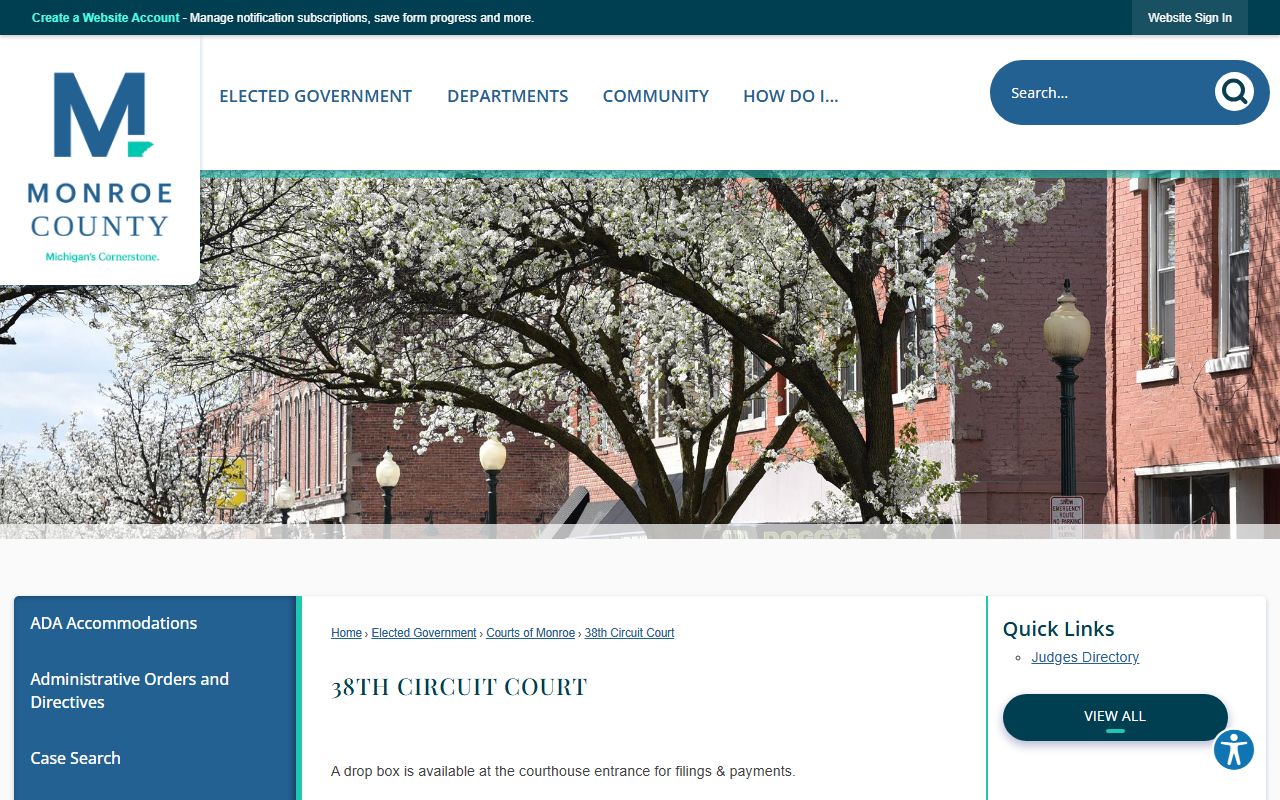
The 38th Circuit Court page lays out its jurisdiction, family division, and appeal role. It also notes a drop box at the courthouse entrance for filings and payments.
| Feature | Circuit Court | District Court | Probate Court |
|---|---|---|---|
| Level | General trial | Limited trial | Specialized |
| Money limit | Over $25,000 | Up to $25,000 | Estate value based |
| Typical cases | Felonies, divorce, PPOs | Traffic, misdemeanors, small claims | Estates, guardianships |
| Records held by | County Clerk | 1st District Court | Probate Court |
Small claims cap out at $6,500 in the district court, and litigants there give up a jury, lawyers, and the right to appeal the judge's ruling. If either side objects, the case moves to the general civil division instead.
Types of Court Records Available in Monroe County
Monroe County court records span the full range of civil and criminal life. The circuit court produces felony files, large civil suits, and family cases. The district court produces traffic, misdemeanor, and small claims files. Probate Court produces estate and guardianship files. Each type carries its own set of documents and its own access rules.
Which Monroe County court made a record shapes where you find it. The list below groups the main record types you can request or search across the county.
- Criminal records - complaints, warrants, arraignment, plea, verdict, and sentence for felonies and misdemeanors.
- Civil records - complaints, answers, motions, judgments, garnishments, and eviction files.
- Family and divorce records - domestic relations, custody, support, and personal protection orders.
- Probate records - estates, wills, guardianships, conservatorships, and mental health matters.
- Traffic records - civil infractions, citation numbers, fines, points, and payment status.
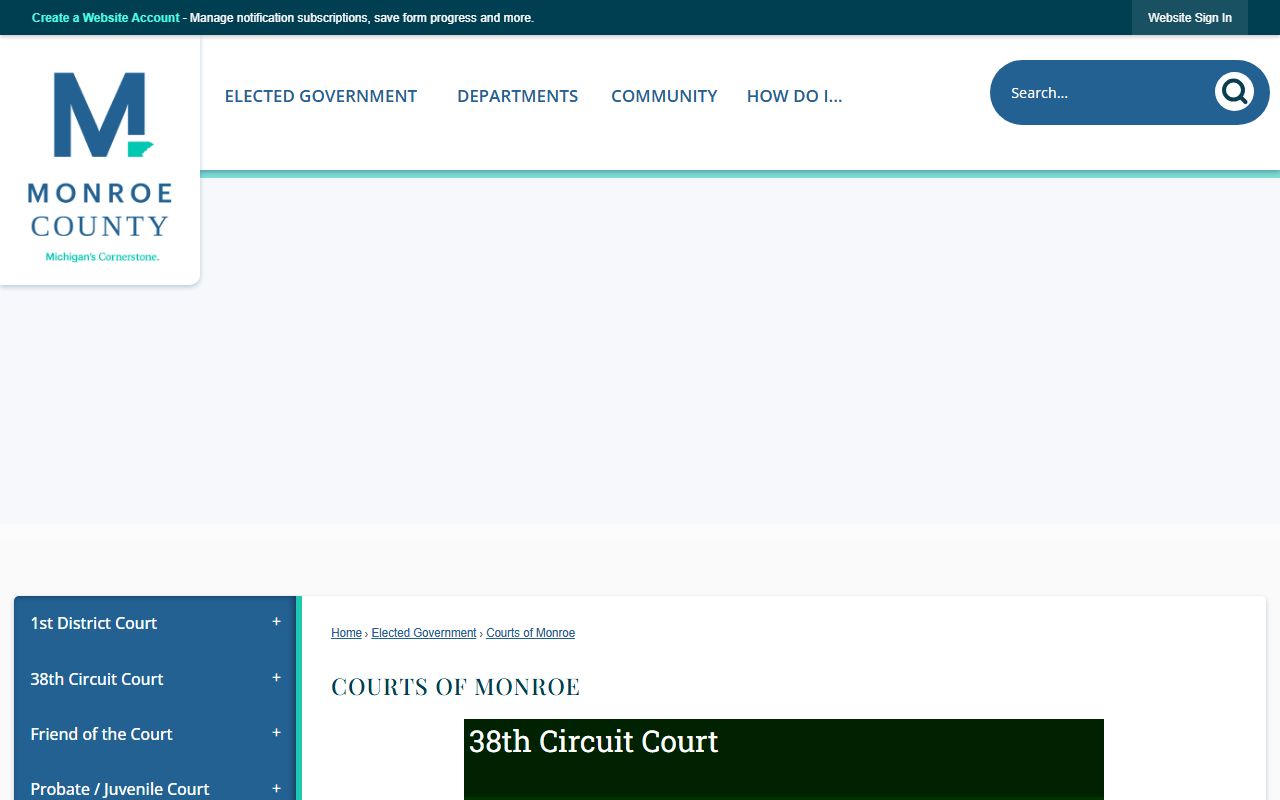
The Courts of Monroe page links each division, from the district and circuit courts to probate, public access, and payment tools. It is the fastest way to jump to the exact record type you need.
Note: Certified copies must come from the court or clerk that owns the file, since online results serve as an index rather than a stamped, court-issued document.
What Monroe County Court Records Show
Open a Monroe County court record and you meet a common set of fields. A Monroe County case number usually ends in a two-letter code that names the case type. From there the record lists the parties, the charges or claims, the events on the docket, and the final outcome. Money items such as fines, costs, and bond also appear.
The table below breaks down the fields you are most likely to see in a public case file.
| Field | What It Shows |
|---|---|
| Case Number | Year, sequence, and a two-letter case-type code |
| Filing Date | When the case opened and its current status |
| Parties | Plaintiff and defendant, or petitioner and respondent |
| Charges / Cause | The charge name, statute, or civil claim |
| Disposition | The outcome, such as dismissed, guilty, or judgment |
| Sentence / Judgment | Fines, jail, probation, or money owed |
Some data stays hidden by rule. Social Security numbers, financial account numbers, victim contact details, and minor names are often redacted from the public view. Sealed and set-aside cases may show nothing at all to a public searcher.
Public Access Laws for Monroe County Court Records
Two bodies of law shape access to Monroe County court records. Michigan court rules govern the Monroe County case files themselves, while the state Freedom of Information Act governs many sheriff and county administrative records. Court files run on court rules first, and public-records requests fill the gaps for police and agency records. The clerk provides certified vital records but does not accept court filings by email or fax.
Key statutes and rules:
Michigan Compiled Laws § 15.231 - sets the state policy that public bodies must open their records to the public, subject to exemptions.
Michigan Court Rule 8.119 - governs how courts keep, share, redact, and seal case records.
Michigan Compiled Laws § 780.621 - the adult set-aside law that can make an eligible conviction nonpublic.
Michigan Compiled Laws § 780.621c - a set-aside order for a traffic offense may not require removal from the driving record.
For police reports and other agency records, the Michigan Attorney General explains the request process on its FOIA resource page. Court case files, though, follow the court rules above rather than a FOIA request.
Records That Are Restricted or Confidential
Not every case is open. Michigan law shields several Monroe County record types from ordinary public search. Juvenile delinquency and child protective files sit behind access limits. Adoption files are sealed. Mental health proceedings in probate hold sensitive medical facts and are often nonpublic. Once a court sets aside a conviction under Clean Slate laws, the public view may go dark even though law enforcement keeps its own access.
To view a sealed or nonpublic record, a person usually needs party status, attorney status, a statutory right, or a court order. A party seeking to clear an eligible conviction files an application in the court where the conviction happened, using the state set-aside form. That means the 1st District Court for district convictions and the 38th Circuit Court for circuit convictions.
Important: A set-aside does not erase every government trace. Certain law-enforcement access and restitution duties can remain, and a traffic set-aside does not strip the offense from a driving record.
Reading Monroe County Court Dockets
A docket is the running list of events in a Monroe County case. The county posts daily dockets through the MiCOURT CourtDisplay tool, one for the 38th Circuit Court and one for the 1st District Court. These schedules show who appears, when, and for what type of hearing. They confirm a court date, but they never replace a summons, subpoena, or notice to appear.
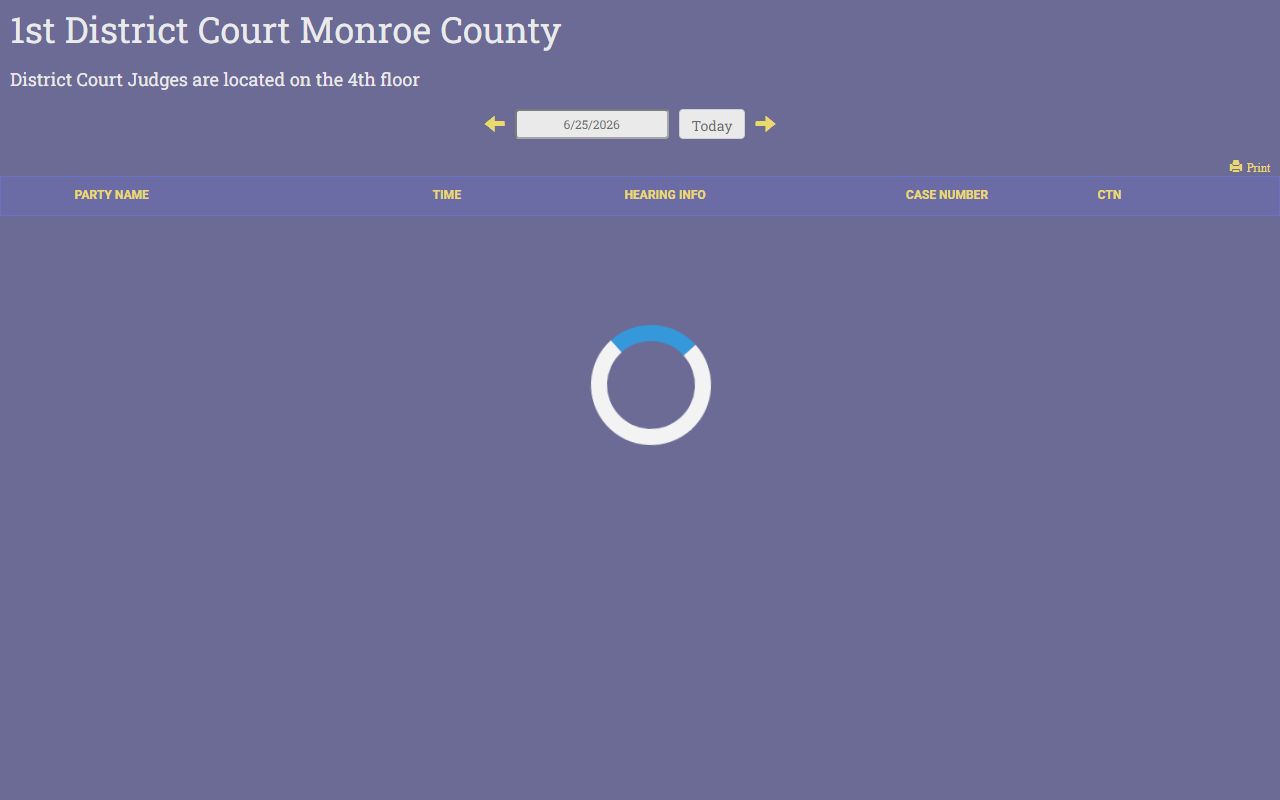
The 1st District Court daily docket lists party names, hearing times, and hearing types for the day. Juvenile and confidential matters may be left out or anonymized.
The MiCOURT case search uses its own set of fields. The table below shows the main inputs, drawn from the portal and its official descriptions, so you can plan a search before you open it.
| Field Label | Type | Required | Notes |
|---|---|---|---|
| Court | Selector | Yes | Pick the participating court, such as the 38th Circuit or 1st District Court |
| Search by | Tabs | Varies | Party name, case number, or related criteria |
| Case Number | Text | For number search | Often ends in a two-letter case-type code |
| Last Name | Text | For name search | Used for party and business searches |
| First Name | Text | Optional | Narrows a person search |
| Case Type | Filter | Optional | Civil, traffic, criminal, domestic, or probate |
Note: A public docket can change through the day as cases settle or move, so call the court if a hearing time looks off before you drive downtown.
Specialty Courts in Monroe County
Monroe County runs several problem-solving courts that focus on treatment rather than jail time. The 38th Circuit Court operates an Adult Drug Treatment Court, an intensive probation program built around five phases and meant to finish within 18 to 24 months. Only people charged with a felony tied to controlled-substance use qualify, and the prosecutor screens each candidate for legal eligibility before a clinical assessment.
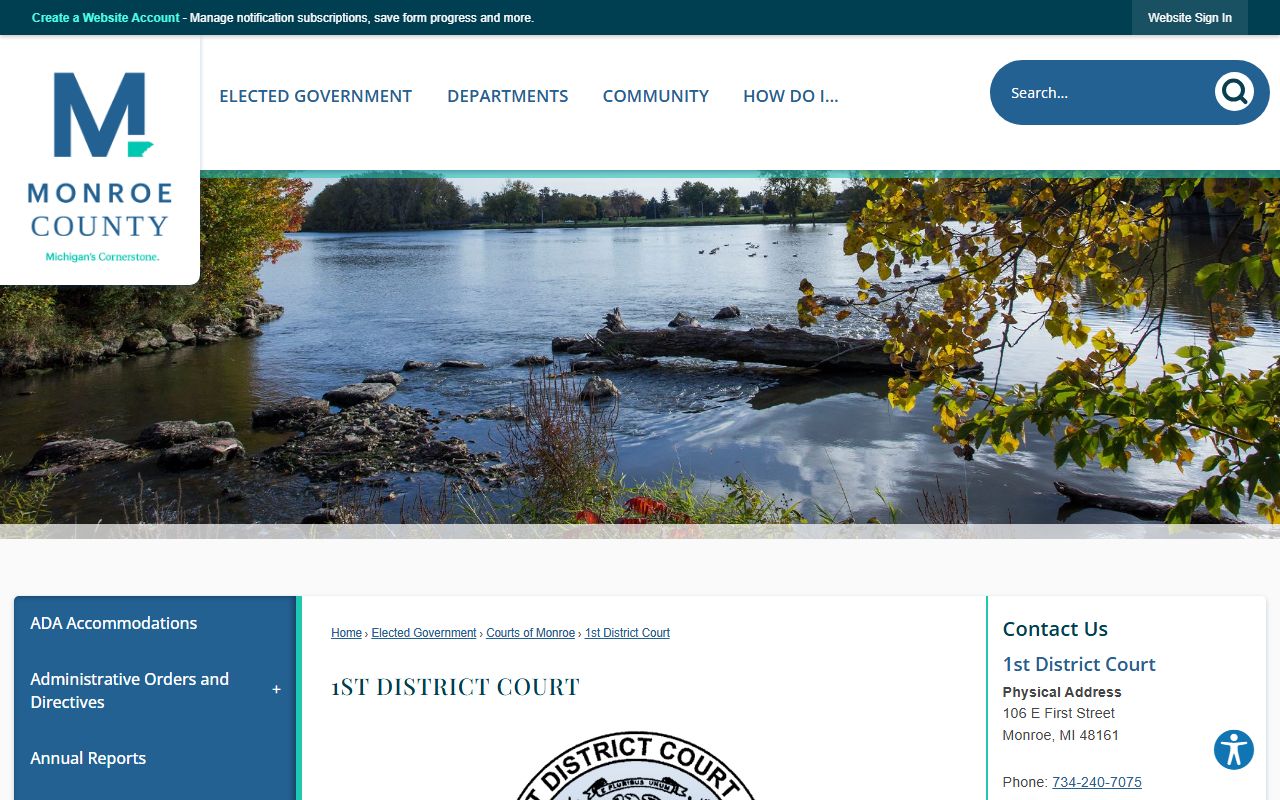
The 1st District Court page lists judge profiles and links to its specialty programs. Those include the Monroe County Sobriety Court, the Mental Health Recovery Court, and the Veterans Treatment Court.
The Sobriety Court is a voluntary district program for people who plead guilty to at least a second drunk-driving offense. It runs a minimum of 16 months and up to 24 months, with status reviews on the first and third Wednesday of each month. Daily test check-ins keep participants accountable across the whole program.
Monroe County Sheriff and Jail Records
The Monroe County Sheriff's Office, led by Sheriff Troy Goodnough, sits at 100 East Second Street in Monroe. Its Records Division keeps sheriff criminal records, crash reports, local record checks, firearm registrations, and FOIA requests. That division is unusually open, staffing its counter 24 hours a day, seven days a week, and it often answers walk-in record checks on the spot.
Current jail custody runs through a separate public portal, and custody notifications run through a statewide service. For the full booking roster and how the lookup works, see the Monroe County inmate records page, and for outstanding warrants see the warrant records page.
Note: A local sheriff record check is not a court-certified criminal history, so a court case search still belongs at the court that owns the file.
Marriage, Divorce, and Probate Records
Vital and family records split across two offices in Monroe County. The Monroe County Clerk handles marriage licenses and certified marriage records, and every copy the office issues carries a raised seal. A marriage applicant fills out an online pre-application, waits at least three days, then finishes the license in person. Divorce has two tracks: a certified record from the clerk and the full case file through the circuit court's family division.
Probate Court keeps estate, guardianship, and conservatorship files. You can browse them through the Monroe County probate records page, and marriage and divorce paths are covered on the marriage and divorce records page. Probate work brings its own vocabulary, and the terms below come up often.
- Testator
- A person who leaves a valid will at death.
- Executor
- The person named to carry out a will and settle the estate.
- Intestate
- Dying without a valid will, so state law directs the estate.
- Conservator
- A person appointed to manage another person's finances.
- Guardian
- A person appointed to make personal or care decisions for a ward.
Monroe County Court Records Fees
Fees in Monroe County vary by office and by service. The Monroe County Sheriff's Records Division charges a set rate for a local record check. Concealed pistol license work at the clerk carries a fixed price. District Court payments add a service fee that changes based on how you pay, whether online, by phone, or at the counter. Probate filing fees appear on a separate official table.
| Item | Amount |
|---|---|
| Local sheriff record check | $15 |
| New concealed pistol license (clerk) | $115 |
| Concealed pistol license renewal | $115 |
| District Court online payment fee | 5%, $2.95 minimum |
| District Court call-center payment fee | 7%, $4.99 minimum |
| District Court at-court card fee | 3.5%, $2.95 minimum |
| Sheriff records card convenience fee | 3%, $2 minimum |
District Court payment rules and service fees are posted on the 1st District Court traffic page. The clerk's certified copy fee is not published in the county's online pages, so confirm that amount directly with the County Clerk before you request one.
Note: The county clerk does not accept personal checks, so bring cash, a card, a money order, or a certified check when a payment is due.
Visit the Monroe County Courthouse
The historic Monroe County Courthouse anchors downtown Monroe. The circuit court, county clerk, district court, and probate counters cluster within the Monroe County courthouse complex, so users should verify the exact counter before arrival. A weapons ban set by Michigan Supreme Court order applies to court facilities, and ADA accommodation requests go through each court's own process rather than at the courtroom door.
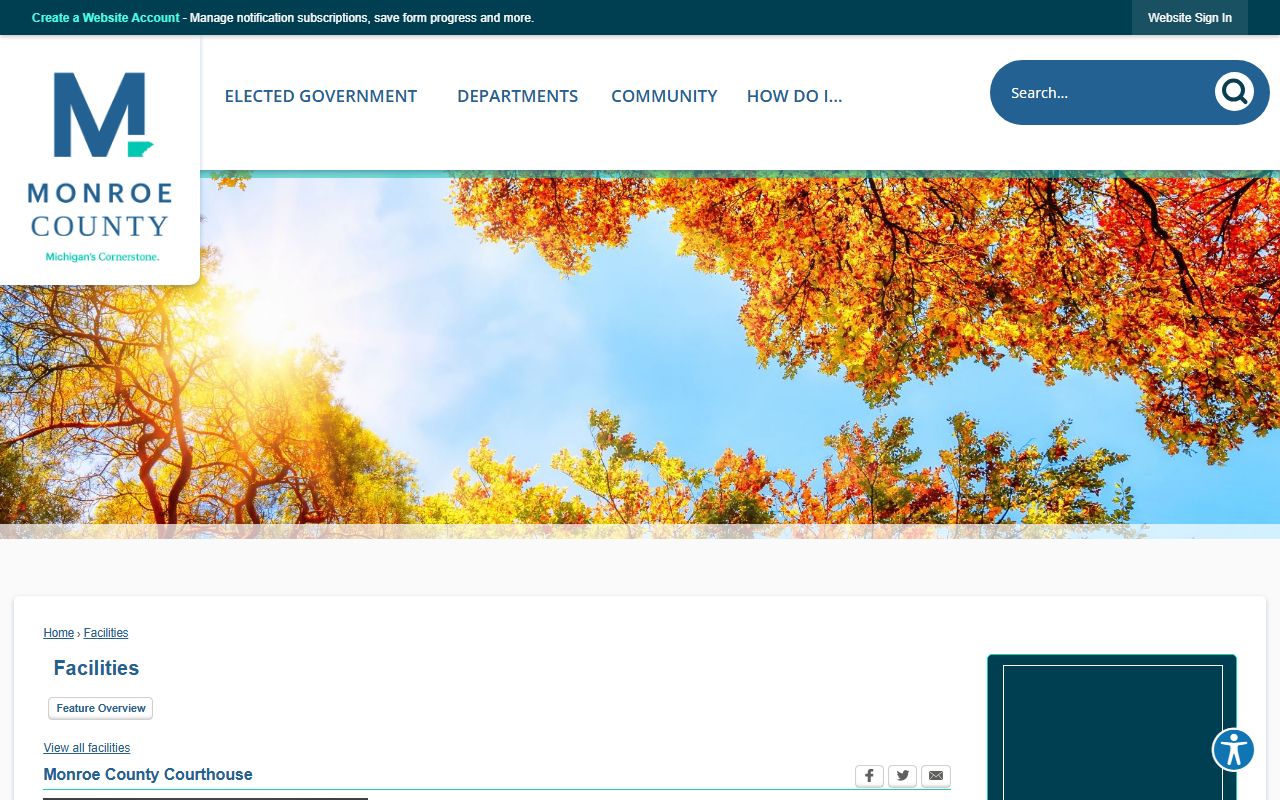
The county's courthouse facility page lists the official address and main phone line. Use the contact card below to plan a visit or a call.
Monroe County Courthouse
125 East Second Street
Monroe, MI 48161-2197
734-240-7000
Downtown Monroe, Michigan
1st District Court & County Clerk
106 East First Street
Monroe, MI 48161
734-240-7075
Sheriff's Records Division
100 East Second Street
Monroe, MI 48161
734-240-7415
Open 24 hours, 7 days a week
History of Monroe County Courts
Monroe County's court records reach far back. The present courthouse was built in 1880, and three additions followed in 1954, 1966, and 1986. An 1879 fire struck the earlier building, and the County Clerk still holds partially burned records, some of them legible back to 1856. Those fragments still serve Monroe County historical research today.
That deep past matters for a modern search. Nineteenth-century probate, land, marriage, and court material may live in paper, in clerk archives, or in fragment form rather than in any online portal. When a record predates the digital era, the clerk and the county history resources often matter more than the case search tool.
Frequently Asked Questions
Are Monroe County court records free to search?
Yes. The MiCOURT Case Search and the Monroe County daily docket displays are free public tools. The Probate Court also runs a free public access portal for probate cases. You may pay a fee only when you ask for a certified copy or a full file from the clerk or court that owns the record.
Which court should I search first?
Match the Monroe County court to the case. Felonies, divorce, and civil suits over $25,000 sit with the 38th Circuit Court and the County Clerk. Traffic, misdemeanors, small claims, and landlord-tenant cases sit with the 1st District Court. Estates and guardianships sit with the Probate Court.
Can I find a Monroe County warrant online?
There is no confirmed public online warrant list for Monroe County. Case search will not reliably show warrant status. For a bench or traffic warrant, call the 1st District Court, and for a felony matter contact the circuit court or the prosecutor.
How do I get a certified copy of a court record?
Contact the court or clerk that holds the file. The County Clerk issues certified vital and circuit records with a raised seal. The clerk does not take court filings by email or fax, but mail and drop boxes are accepted for filings.
Do online records show the full case file?
No. Online results are an index and docket, not the complete official file. Sealed, nonpublic, limited-access, and older paper records require direct contact with the court. Always verify a critical detail with the originating office.
Where are marriage and divorce records kept?
The County Clerk keeps marriage licenses and certified marriage and divorce records. The full divorce case file lives with the circuit court's family division. Marriage applicants apply online, wait at least three days, then finish the license in person.
How do I check if someone is in the Monroe County Jail?
Current jail custody runs through a public inmate portal, and a statewide service sends custody notifications. The county's inmate records page walks through the lookup and the fields it shows for booked individuals.